Skip to content
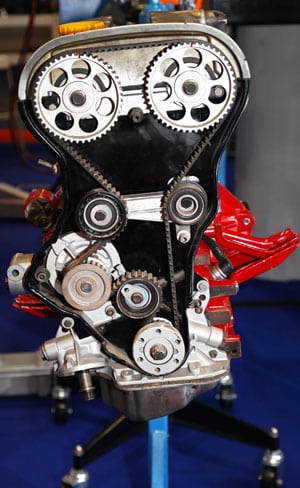
Inside your car’s engine, there is a component that works tirelessly and unseen, but is absolutely critical to the engine’s operation: the timing belt. This simple-looking rubber belt has one of the most important jobs in the entire engine. Unfortunately, it also has a finite lifespan, and if it fails, it can cause catastrophic and incredibly expensive engine damage. This is why vehicle manufacturers provide a strict replacement interval for the timing belt. Adhering to this schedule is not a suggestion; it is one of the most important pieces of preventative maintenance you can perform to protect your engine from a devastating failure.
What Does a Timing Belt Do?
To understand why a timing belt is so important, you need to understand the basics of how your engine works. An internal combustion engine is often called a “four-stroke” engine. For it to run, four things must happen in a perfectly synchronized sequence: intake, compression, combustion, and exhaust. This sequence is controlled by the opening and closing of valves, which is controlled by the camshaft, and the up-and-down movement of the pistons, which is controlled by the crankshaft.
The timing belt is a toothed rubber belt that connects the crankshaft to the camshaft(s). Its job is to ensure that the camshaft and the crankshaft are always turning in perfect synchronization. This guarantees that the engine’s valves open and close at the exact right moment in relation to the position of the pistons.
The Catastrophic Consequences of a Broken Timing Belt
A timing belt is a wear-and-tear item. Over tens of thousands of miles, the rubber can degrade, stretch, and crack. If the belt is not replaced at its recommended interval, it will eventually snap. When the timing belt breaks on what is known as an “interference engine” (which includes the majority of modern engines), the consequences are immediate and disastrous.
- The Collision: When the belt snaps, the camshaft stops turning instantly, but the crankshaft continues to spin due to the car’s momentum. This means the pistons will continue to move up and down, but the valves will be left frozen in place, some of them in the open position. The upward-traveling pistons will then violently collide with the open valves.
- The Damage: This collision will, at a minimum, bend all the open valves and can also damage the pistons and the cylinder head. The result is a catastrophic engine failure that will require a complete engine rebuild or replacement, a repair that can cost thousands upon thousands of dollars.
As automotive resources consistently explain, a broken timing belt on an interference engine is one of the most expensive mechanical failures a vehicle can experience.
When Should You Replace Your Timing Belt?
There are no obvious warning signs that a timing belt is about to fail. It does not typically get noisy or cause performance issues before it breaks. The only way to prevent a failure is to replace it proactively as part of your vehicle’s scheduled maintenance.
- Check Your Owner’s Manual: Your vehicle’s manufacturer provides a specific replacement interval for the timing belt, which is typically between 60,000 and 100,000 miles. You must adhere to this schedule.
- Replace the Whole System: When the timing belt is replaced, it is standard practice to also replace the other components that are part of the system, such as the water pump (which is often driven by the timing belt), the tensioner, and the idler pulleys. These parts have a similar lifespan to the belt itself, and replacing them at the same time is much more cost-effective than having to do the same labor-intensive job again a few months later.
Your Dallas Timing Belt Replacement Experts
Do not gamble with a timing belt. The cost of a proactive replacement is a tiny fraction of the cost of rebuilding your engine after a failure. For drivers in the Dallas, TX area, the certified technicians at Allstate Transmissions & Auto Repair can tell you your vehicle’s recommended replacement interval and can perform this critical service. We are your experts for timing belt replacement. Contact us today for a consultation or to schedule this vital service.